Dataset Information (Read-Only Properties)
Getting there
Databridge Servers > Client Managers > Settings > Customize > (select data set ) > Settings > Information
The read-only properties for a data set are organized in the following sections:
The editable properties also appear in the Properties page for the data set.
Basic Properties
This section has two properties: Active and Mode, which corresponds to the active and ds_mode columns in the DATASETS Client control table. Both properties can be edited from the Data Set Properties Page.
DMSII Information
This section contains two items Item name Prefix and Extract Priority, they correspond to the values of the item_name_prefix and extract_priority in the DATASESTS Client control table. Both of these can be edited from the Data Set Properties Page.
Miscellaneous Flags
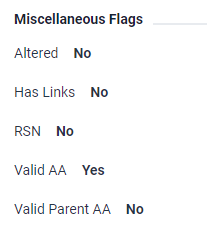
This section contains the values for relevant bits in the misc_flags column of the DATASETS Client control table that are useful when customizing the data set. The Altered bit (DSFLG_Altered) when set, indicates that the data was altered by the Databridge Support library. The Has Links bit (DSFLG_Links) when set, indicates that the data set has links to other data sets. The RSN bit (DSFLG_Static_AA) when set, indicates that the Databridge Engine is using RSNs in place of AA Values. The Valid AA bit (DSFLG_Valid_AA) when set, indicates that the data set has valid AA Values. The Valid Parent AA bit (DSFLG_Uses_Parent_AA) when set, indicates that the data set, which is an embedded data set whose parent data set has valid AA Values. The embedded data set uses a column named parent_aa as a foreign key that points to the parent data set record with the given AA value.
Options
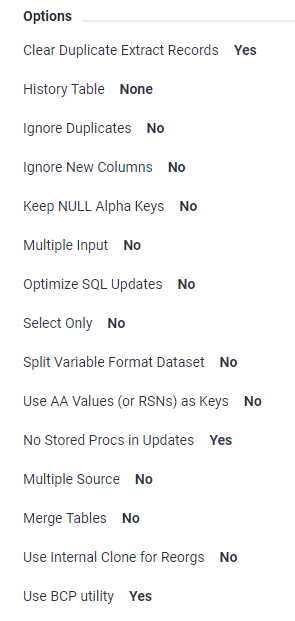
This section contains a series of options that represents individual bits in the ds_options column of the DATASETS table. The History Tables parameter, which controls two mutually exclusive ds_options is represented by a list box with 3 entries (None, Save History and Save History Only to prevent both bits from being set).
Refer to the DATASETS Client control table in the Databridge Client Administrator's Guide for more information about these bits. The various option bits are listed below with their corresponding names used in the Databridge Client Administrator's Guide and the configuration file parameter(s) which define their initial values when applicable. You can change the setting for these bits on a data set by dataset basis using customization. You should set the parameter in the configuration file using the Configure command to reflect the most commonly used settings, as this will reduce the amount of changes needed.
| Name in UI | Name in Client Administrator's Guide | mask | config parameter |
|---|---|---|---|
| Clear Duplicate Extract records | DSOPT_Clrdup_Recs | 32,768 | clr_dup_extr_recs |
| History Tables > Save History | DSOPT_Save_Updates | 8 | history_tables = 1 |
| History Tables > Save History Only | DSOPT_HistoryOnly | 8192 | history_tables = 2 |
| Ignore Duplicates | DSOPT_Ignore_Dups | 32 | suppress_dup_warnings |
| Ignore New Columns | DSOPT_Supp_New_Columns | 256 | suppress_new_columns |
| Keep NULL Alapha keys | DSOPT_Keep_Null_Alpha_Keys | 128 | |
| Multiple Input | DSOPT_MultiInput | 512 | |
| Optimize SQL Updates | DSOPT_Use_bi_ai | 1 | optimize_updates |
| Select Only | DSOPT_Select_Only | 64 | |
| Split variable Format Dataset | DSOPT_Use_AA_Only | 65,536 | split_varfmt_dataset |
| Use AA Values (or RSNs) as Keys | DSOPT_Use_AA_Only | 16,384 | |
| No Stored Procs in Updates | DSOPT_No_StoredProcs | 4 | use_stored_procs |
| Multiple Source | DSOPT_MultiSource | 1024 | |
| Merged Tables | DSOPT_MergedTables | 2048 | |
| Use Internal Clone | DSOPT_Internal_Clone | 4,194,304 | use_internal_clone |
| Use BCP utility | DSUPT_Use_BCP | 16,777,216 | use_bcp |
See the DATASETS Client Control table in the Databridge Client Administrator's Guide for more information. You can change the setting for these bits on a data set on a date set basis using customization. You should set the parameter in the configuration file to reflect the most commonly used setting, as this will reduce the amount of changes needed
Virtual Data Set
This section allows you to link virtual data sets and real data sets from which they are derived using the virtual_ds_num, real_ds_num and real_ds-rectype columns in the DATASETS client control table. The two controls are list-boxes that contain all the qualifying data sets that are available.
User Columns
This section lists the various user columns that will be added to the data set. These bits default to the value defined by the external_columns parameter in the Client configuration file. This set of options allows you to further customize the user columns to be used for the tables derived from this data set.