or convert (Format 4)
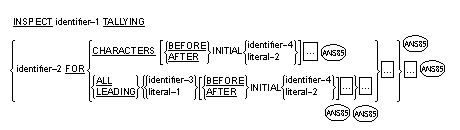
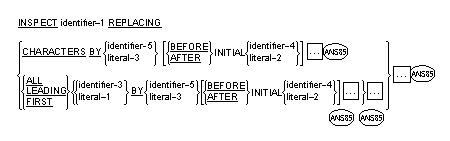
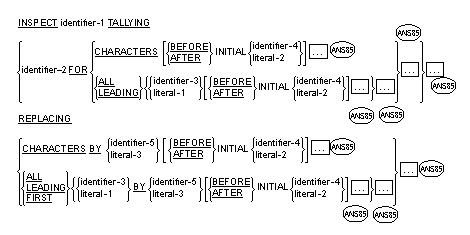
 The INSPECT statement provides the ability to tally (Format 1), replace (Format 2), tally and replace (Format 3)
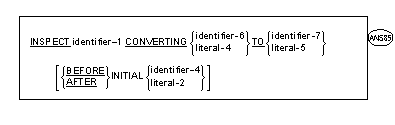
or convert (Format 4)
occurrences of single characters or group of characters in a data item.
Format
4 
 When identifier-1 is of class national, the
class of the figurative constant is national; when identifier-1 is of class
boolean, the figurative constant is of class boolean and only the figurative
constant ZERO may be specified; otherwise, the class of the figurative constant
is alphanumeric.
When identifier-1 is of class national, the
class of the figurative constant is national; when identifier-1 is of class
boolean, the figurative constant is of class boolean and only the figurative
constant ZERO may be specified; otherwise, the class of the figurative constant
is alphanumeric.
and /;
or one AFTER phrase can be specified for any one ALL, LEADING, CHARACTERS, FIRST
or
CONVERTING
phrase.
All identifiers, except identifier-2
(the TALLYING field), can be external floating-point items. External
floating-point items are treated as if redefined as alphanumeric with the
INSPECT statement referring to the alphanumeric item. This restriction does not apply
to literal-2 or identifier-4.
Format
4 The size of literal-5 or the data item referenced
by identifier-7 must be equal to the size of literal-4 or the data item
referenced by identifier-6. When a figurative constant is used as literal-5,
the size of the figurative constant is equal to the size of literal-4 or the
size of the data item referenced by identifier-6. The same character must not appear more than once
either in literal-4 or in the data item referenced by identifier-6. For the purpose of determining
its length, identifier-1 is treated as if it were a sending data item. (See the
topic
The OCCURS
Clause.) or is a
function-identifier
, the subscript
or
function-identifier
is evaluated only once as the first operation in the execution of the INSPECT statement.
Identifier-1 is a sending data
item. The position of this first occurrence is determined before the first cycle of the comparison operation described in General Rule 12 is begun. If, on any comparison cycle, literal-1, or the implied operand of the CHARACTERS phrase is not eligible to participate, it is considered not to match the contents of the data item referenced by identifier-1. If there is no occurrence of literal-2, in the contents of the data item referenced by identifier-1, its associated literal-1, or the implied operand of the CHARACTERS phrase participates in the comparison operation as though the BEFORE phrase had not been specified.
The position of this first occurrence is determined before the first cycle of the comparison operation described in General Rule 12 is begun. If, on any comparison cycle, literal-1, or the implied operand of the CHARACTERS phrase is not eligible to participate, it is considered not to match the contents of the data item referenced by identifier-1. If there is no occurrence of literal-2, in the contents of the data item referenced by identifier-1, its associated literal-1, or the implied operand of the CHARACTERS phrase is never eligible to participate in the comparison operation.
Format
4 A Format 4 INSPECT statement is interpreted and
executed as though a Format 2 INSPECT statement specifying the same
identifier-1 had been written with a series of ALL phrases, one for each
character of literal-4. The effect is as if each of these ALL phrases
referenced, as literal-1, a single character of literal-4 and referenced, as
literal-3, the corresponding single character of literal-5. Correspondence
between the characters of literal-4 and the characters of literal-5 is by
ordinal position within the data item. If identifier-4, identifier-6 or identifier-7
occupies the same storage area as identifier-1, the result of the execution of
this statement is undefined, even if they are defined by the same data
description entry.