The SET statement is used to alter
the status of external switches.
The SET statement is used to alter
the status of external switches. The SET statement is used to alter
the status of external switches.
The SET statement is used to alter
the value of conditional variables.

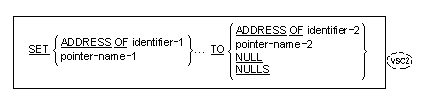
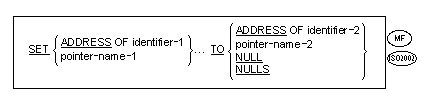
 The SET statement is used to
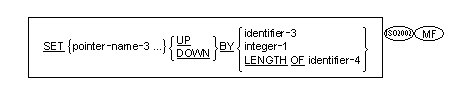
assign the address of a data item to a pointer data item. It is also used to
adjust the contents of a pointer data item.
The SET statement is used to
assign the address of a data item to a pointer data item. It is also used to
adjust the contents of a pointer data item.
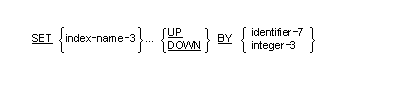
The SET statement establishes reference points for table handling operations by setting indices associated with table elements.
The SET statement is used to assign the
address of a program or an entry-point in a program to a procedure-pointer data
item.
 The SET statement is used to
assign the address of a pointer to a program-pointer data item.
The SET statement is used to
assign the address of a pointer to a program-pointer data item.
The SET statement is used to
assign object references.
The SET statement is used to alter the
value of a synchronization data item.
The SET statement is used to assign the
address of a synchronization data item to another synchronization data
item.
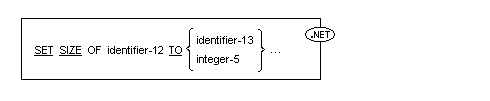
 The SET statement is used to alter the size of a .NET native
array.
The SET statement is used to alter the size of a .NET native
array.
The SET statement is used to initialize the contents of a .NET
native array and to set the array size based on those
contents.
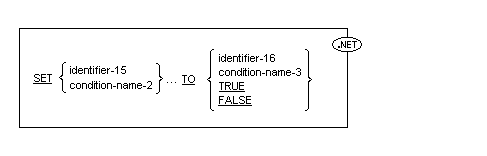
The SET statement is used to alter the value of a boolean data
item with usage CONDITION-VALUE.
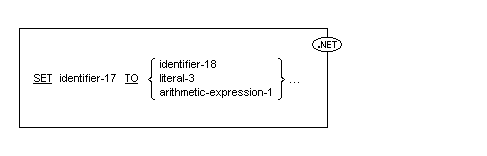
The SET statement is used to alter the value of a data item with a
.NET native type.
Format
1 (Switch-setting)Format
2 (Condition-setting)Format 3
(Data-pointer-assignment)Format
4 (Data-pointer-assignment)Format
5 (Data-pointer-arithmetic)Format 8
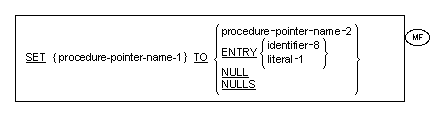
(Procedure-pointer-assignment)Format
9 (Object-reference-assignment)Format 10
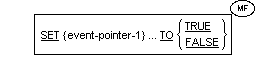
(Value-of-Event-pointer)Format 11
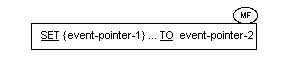
(Address-of-Event-pointer)Format 12
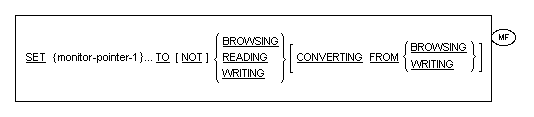
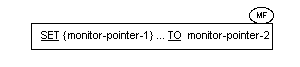
(Value-of-Monitor-pointer)Format 13
(Address-of-Monitor-pointer)Format 14
(Value-of-Mutex-pointer)Format 15
(Address-of-Mutex-pointer)Format 16
(Value-of-Semaphore-pointer)Format 17
(Address-of-Semaphore-pointer)Format
18 (Size-of-array)Format
19 (Content-of-array)Format
20 (Boolean-setting)Format
21 (.NET-data-setting)The data item referenced by pointer-name-1, pointer-name-3 or procedure-pointer-name-1 or the COBOL system area implied by ADDRESS OF identifier-1 represents the receiving area.
Identifier-3, integer-1 or LENGTH OF identifier-4 represents the increment value.
Mnemonic-name-1 must be associated with an
external switch, the status of which can be altered.
See the topic
The Special-Names
Paragraph for details of which external switches can
be referenced in the SET statement.
Condition-name-1 must be associated with a
conditional variable. If the FALSE phrase is specified,
the FALSE phrase must be specified in the VALUE clause of the Data Description
entry for condition-name-1. Each FALSE or TRUE phrase applies to
the occurrences of condition-name-1 that precede that phrase and follow a
previous FALSE or TRUE phrase, if any. Identifier-1 must reference a level 01 or level
77 data item that is declared in the Linkage Section.
 Identifier-1 must be declared in
the Linkage Section, the Local-Storage Section or the Working-Storage
Section
Identifier-1 must be declared in
the Linkage Section, the Local-Storage Section or the Working-Storage
Section
Identifier-2
must reference a data item with a level of 77 or between 01 and 49 inclusive.
Identifier-2 must be
declared in the Linkage Section.
Pointer-name-1, pointer-name-2 must each be an
identifier that references an elementary data item with USAGE IS POINTER. Pointer-name-3 must be an identifier that references
an elementary data item with USAGE IS POINTER. Identifier-3 must be an elementary numeric integer.
Integer-1 may be signed.
Procedure-pointer-name-1 and procedure-pointer-name-2 must
each be an identifier that references an elementary data item with USAGE IS
PROCEDURE-POINTER. Identifier-8 must be defined as an alphanumeric data
item such that its value can be a COBOL or a non-COBOL program name. Literal-1 must be a nonnumeric literal. Identifier-9 must be any item of class
object that is permitted as a receiving item. Identifier-10 must be a class-name or an
object reference; the predefined object reference SUPER must not be specified.
If the data item referenced by identifier-9
is a universal object reference, the only predefined object references that may
be specified for identifier-10 are SELF and NULL. If the data item referenced by identifier-9
is described with an interface-name that identifies the interface int-1, the
data item referenced by identifier-10 must be one of the following:
If the data item referenced by identifier-9
is described with a class-name, the data item referenced by identifier-10 must
be one of the following:
If the data item referenced by identifier-9
is described with an ACTIVE-CLASS phrase, the data item referenced by
identifier-10 must be one of the following:
Event-pointer-1 must be defined as a data item with USAGE
EVENT-POINTER. Event-pointer-1 and event-pointer-2 must be defined
as data items with USAGE EVENT-POINTER.
Monitor-pointer-1 must be defined as a data item with
USAGE MONITOR-POINTER. If the NOT phrase is specified, then the CONVERTING
phrase must not be specified. Monitor-pointer-1 and monitor-pointer-2 must be
defined as data items with USAGE MONITOR-POINTER.
Mutex-pointer-1 must be defined as a data item with USAGE
MUTEX-POINTER. Mutex-pointer-1 and mutex-pointer-2 must be defined
as data items with USAGE MUTEX-POINTER.
Semaphore-pointer-1 must be defined as a data item with
USAGE SEMAPHORE-POINTER. Identifier-11 must reference an integer. Semaphore-pointer-1 and semaphore-pointer-2 must be
defined as data items with USAGE SEMAPHORE-POINTER. Identifier-12 must be described with a format 3 OCCURS
clause. Identifier-13 must describe an
integer.The number of operands after the TO phrase must not
exceed the number of dimensions specified for
identifier-12.Identifier-14 must be described with a format 3 OCCURS clause as
either a one-dimensional array or a rectangular array. Literal-2 must be a valid literal for a VALUE clause
describing the subject of the entry.Parentheses may be used within the repetitions of
literal-2 to separate the values into subarrays.Identifier-15 and identifier-16 must have usage
CONDITION-VALUE. Condition-name-2 and condition-name-3 must be associated
with conditional variables.If
condition-name-2 is specified and the TRUE phrase is not specified, the FALSE
phrase must be specified in the VALUE clause of the Data Description entry for
condition-name-2. Identifier-17 is the receiving item.Identifier-18, literal-3 or arithmetic-expression-1 is
the sending item.The SET statement is legal if any of the following are
true:The status of each external switch associated
with the specified mnemonic-name-1 is modified such that the truth value
resulting from evaluation of a condition-name associated with that switch
reflects an on status if the ON phrase is specified, or an off status if the
OFF phrase is specified. (See the topic
Switch-Status
Condition in the chapter Procedure
Division.) The literal in the VALUE clause associated with
condition-name-1 is placed in the conditional variable according to the rules
of the VALUE clause (see the section
The VALUE
Clause.) If more than one literal is specified in the
VALUE clause, the conditional variable is set to the value of the first literal
that appears in the VALUE clause. If multiple condition-names are specified, the
results are the same as if a separate SET statement had been written for each
condition-name-1 in the same order as specified in the SET statement. If the FALSE phrase is specified, the literal in the
FALSE phrase of the VALUE clause associated with condition-name-1 is placed in
the conditional variable according to the rules for the VALUE clause. (See the
topic
The VALUE
Clause.) The sending value represents the address of a
data item. If pointer-name-2 is specified, the sending value is the value
contained with the data item referenced by pointer-name-2. If ADDRESS OF
identifier-2 is specified, the sending value represents the address of
identifier-2. If pointer-name-1 is specified, the sending
value is moved to the data name referenced by pointer-name-1. If ADDRESS OF identifier-1 is specified, the
sending value is moved to a COBOL system area and the runtime element
subsequently operates such that the area of storage referenced by identifier-1
is located at the address represented by the sending value.
Whether or not the link is retained
between invocations of a subprogram is dependent on the STICKY-LINKAGE Compiler
directive.
Before execution of the SET statement, the value of
the data item referenced by pointer-name-3 must represent the address of a data
item within a logical record, the original address. After execution of the SET
statement, the value of the data item referenced by pointer-name-3 represents
the new address. If the original address and the new address do not both lie
within the same logical record, (or, for environments in which address space is
segmented, within the same segment) then the results of using the value of the
data item referenced by pointer-name-3 are undefined. If the UP clause is specified, the new address is
formed by adding the number of bytes given by the increment value to the
original address. If the DOWN clause is specified, the new address is
formed by subtracting the number of bytes given by the increment value from the
original address. | Sending Item | Receiving Item | ||
|---|---|---|---|
| Integer Data Item | Index-Name | Index Data Item | |
| Integer Literal | No/11c | Valid/11a | No/11b |
| Integer Data Item | No/11c | Valid/11a | No/11b |
| Index-Name | Valid/11c | Valid/11a | Valid/11b1 |
| Index Data Item | No/11c | Valid/11a1 | Valid/11b1 |
1 = No conversion takes place.
If index-name-2 is specified, the value of the index before the execution of the SET statement must correspond to an occurrence number of an element in the table associated with index-name-1.
If index-name-3 is specified, the value of the index both before and after the execution of the SET statement must correspond to an occurrence number of an element in the table associated with index-name-3.
The sending value represents the address of the
start of a procedure within a COBOL or non-COBOL program. The sending value is moved to the data item
referenced by procedure-pointer-name-1. If procedure-pointer-name-2 is specified, the
sending value is the value contained within the data item referenced by
procedure-pointer-name-2. Literal-1 or the content of the data item referenced
by identifier-8 is the name of the referenced procedure. If the referenced
procedure is a COBOL procedure, the name of the referenced procedure must
contain the program-name contained in the Program-ID paragraph of the
referenced program or the entry-name contained in the ENTRY statement of the
referenced procedure.
If the program being called is not a COBOL program,
the rules for the formation of the program or procedure name are given in your
COBOL system documentation on interfacing.
If the referenced procedure has been previously
made available and remains available at the time of execution of the SET
statement, then the sending value represents the address of the referenced
procedure.
If the referenced procedure is not available at the
time of execution of the SET statement, then the sending value represents the
address of a COBOL system error procedure.
If identifer-10 is an object reference, a
reference to the object identified by identifier-10 is placed into each data
item referenced by identifier-9 in the order specified. If identifier-10 is a class-name, a
reference to the factory object of the class identified by identifier-10 is
placed into each data item referenced by identifier-9 in the order specified.
If more than one event-pointer-1 is
specified, the results are the same as if a separate SET statement had been
written for each event-pointer-1 in the same order as specified in the SET
statement. The execution of the SET statement sets the value of
the event referenced by event-pointer-1 to TRUE or FALSE.
Note: When an event is set to FALSE, the execution of any thread
which executes a WAIT statement which references that event suspends until the
event is set to TRUE in another thread.
Event-pointer-1 is set to reference the same event
data item that event-pointer-2 references. If more than one monitor-pointer-1 is specified, the
results are the same as if a separate SET statement had been written for each
monitor-pointer-1 in the same order as specified in the SET statement. If the NOT phrase is not specified, the value of the
monitor referenced by monitor-pointer-1 is set to one of BROWSING, READING, or
WRITING, thus establishing the corresponding form of lock. This specific lock
type for this specific monitor must be eventually released by a SET statement
either with a matching NOT phrase or a matching CONVERTING FROM phrase.
For example, the lock established by
SET mon-1 TO READING
can be cleared by
SET mon-1 TO NOT READING
The CONVERTING phrase is used to
change the current type of lock established on a monitor. The lock type
specified in the FROM phrase must be currently established by that thread and
upon successful execution of the statement, that lock will have been changed,
in one atomic operation, to the lock type specified in the TO phrase. Nested locks can be obtained by the
execution of successive SET monitor statements with no intervening SET
statement that releases the lock. Once a READING lock is established, no
BROWSING or WRITING lock is allowed to nest within that thread. Once a BROWSING
lock or a WRITING lock is established, any other level of lock is allowed to
nest within that thread. Monitor-pointer-1 is set to reference the same
monitor data item that monitor-pointer-2 references. If more than one mutex-pointer-1 is specified, the
results are the same as if a separate SET statement had been written for each
mutex-pointer-1 in the same order as specified in the SET statement. The execution of the SET statement sets the value of
the mutex referenced by mutex-pointer-1 to ON or OFF. When a mutex is set to ON, the execution of any
thread that attempts to set that mutex to ON suspends until the mutex is set to
OFF in the thread that set it ON. Mutex-pointer-1 is set to reference the same mutex
data item that mutex-pointer-2 references. If more than one semaphore-pointer-1
is specified, the results are the same as if a separate SET statement had been
written for each semaphore-pointer-1 in the same order as specified in the SET
statement. The contents of the semaphore data item referenced
by semaphore-pointer-1 are incremented (UP BY) or decremented (DOWN BY) by a
value that corresponds to the value of integer-4 or the data item referenced by
identifier-11; thereafter, the process is repeated for each recurrence of
semaphore-pointer-1. For each repetition, the value of the data item referenced
by identifier-11 is used as it was at the beginning of the execution of the
statement. If a semaphore is set DOWN BY n and the semaphore is
less than n, the thread is suspended until another thread raises the semaphore
to above n. Semaphore-pointer-1 is set to reference the same
semaphore data item that semaphore-pointer-2 references. The SET statement sets the size of the .NET array
described by identifier-12 to the contents of the data item referenced by
identifier-13 or the value of integer-5.The SET statement creates an a .NET array of the size
required to contain the values specified by the repetitions of literal-2 and
initializes the array to the specfied values..The contents of the data-item referenced by identifier-15 or
condition-item-2 is set to the contents of the data item referencesby
identifier-16 or condition-name-3 or to TRUE or FALSE. If
identifier-17 is alphanumeric or national, the ToString method is automatically
invoked on the sending item and the resulting string moved to the data item
referenced by identifier-17. Note that the ToString method exists for any class
since it is implemented in System.Object.The sending item is moved to the receiving
item.