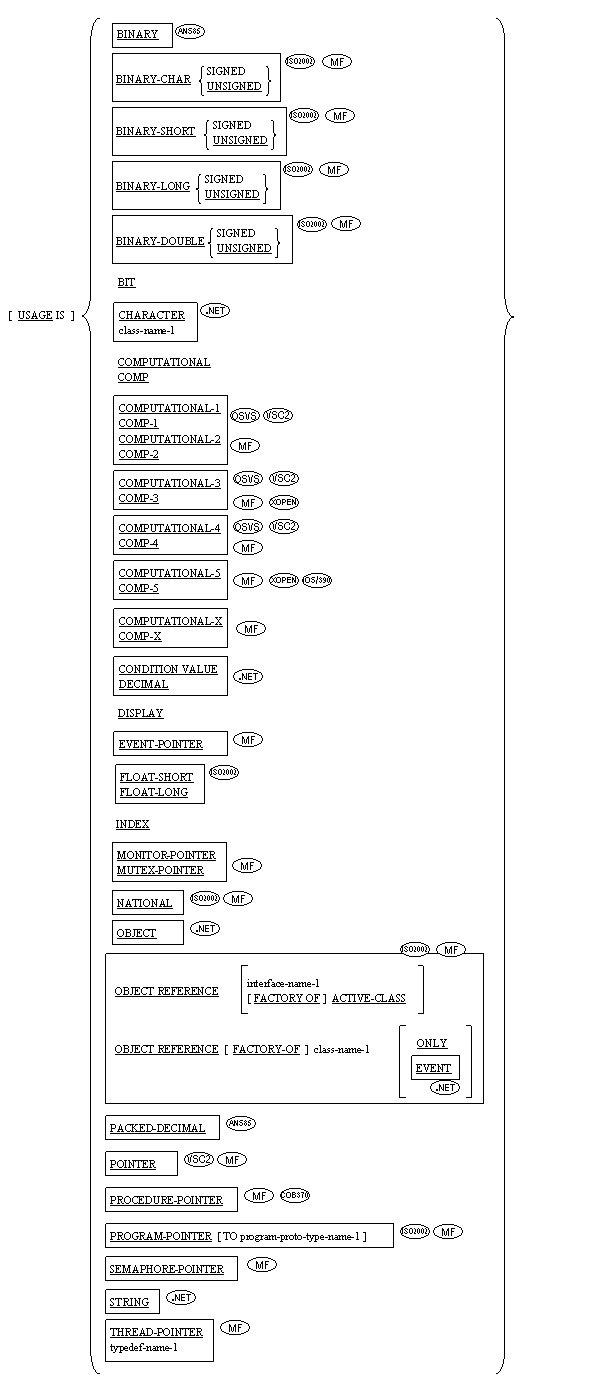
The USAGE clause specifies the format of a data item in the computer storage.
 , BINARY,
PACKED-DECIMAL
, BINARY,
PACKED-DECIMAL


 ,
COMPUTATIONAL-3
,
COMPUTATIONAL-3
,
COMPUTATIONAL-4
 ,
or COMPUTATIONAL-5
,
or COMPUTATIONAL-5
must be declared with a PICTURE character-string that describes a numeric item (i.e. a PICTURE character-string that contains only the symbols "P", "S", "V", and "9"). See the topic The PICTURE Clause.
An elementary data item whose
declaration contains no USAGE clause and that is subordinate to a group item
whose declaration contains a USAGE clause specifying a format from the list may
be declared with a PICTURE character-string that describes an alphabetic,
alphanumeric, alphanumeric-edited or numeric-edited data item.
An elementary data
item whose declaration contains, or an elementary data item subordinate to a
group item whose declaration contains, a USAGE clause specifying
COMPUTATIONAL-5
or
COMPUTATIONAL-X
must be declared with a picture character-string that describes a numeric item
or describes an
alphanumeric item with a size of between one and eight bytes inclusive. If it
describes an alphanumeric item of size 1, 2, 3, 4, 5, 6, 7, or 8 bytes, then
this is equivalent to specifying an integer item with 2, 4, 7, 9, 12, 14, 16 or
18 decimal digit positions respectively
.
When COMPUTATIONAL-X is specified
and the PICTURE character-string describes a numeric item, then that item must
be unsigned.
The SYNCHRONIZED clause
can be specified for data items whose usage is INDEX.
COMP-1 is an
abbreviation for COMPUTATIONAL-1.
COMP-2 is an
abbreviation for COMPUTATIONAL-2.
COMP-3 is an
abbreviation for COMPUTATIONAL-3.
COMP-4 is an
abbreviation for COMPUTATIONAL-4.
COMP-5 is an
abbreviation for COMPUTATIONAL-5.
COMP-X is an abbreviation for
COMPUTATIONAL-X.
the
USING statement of an ENTRY statement,
an intrinsic
function argument
 the
USING phrase of an INVOKE statement, an inline method invocation
argument
the
USING phrase of an INVOKE statement, an inline method invocation
argument
an
INITIALIZE statement
or the USING phrase of a CALL statement.
 A pointer
 or
procedure-pointer
item can
be referenced explicitly only in a SET statement, a relation condition, a CALL
statement, the USING phrase of a Procedure Division, the USING statement of an
ENTRY statement
an INVOKE
statement, the argument list of an inline invocation of a method, the argument
list of a function,
OBJECT,
POINTER,
or PROCEDURE-POINTER
EVENT-POINTER, MONITOR-POINTER,
MUTEX-POINTER, PROCEDURE-POINTER, SEMAPHORE-POINTER or THREAD-POINTER
clause must not be a conditional variable.
Typedef-name-1 must be previously
defined in the same source file as a record with the TYPEDEF clause. If USAGE typedef-name-1 is
specified, the following clauses cannot also be specified:
It is an error to specify USAGE
typedef-name-1 if there is an explicit USAGE clause at a higher level in the
same hierarchy. It is an error to specify any
subordinate items (items with a higher level number other than 78) immediately
following an item defined with USAGE typedef-name-1. The USAGE OBJECT REFERENCE
clause must not be specified in the data description entry for a group item,
but may be specified on subordinate elementary data items. The USAGE
OBJECT REFERENCE clause must not be specified in the File Section.
The USAGE OBJECT REFERENCE clause
can be specified in the File Section.
Note: Whether the object reference still references an active object depends on the application logic.
The ACTIVE-CLASS phrase can be
specified only in a factory definition, object definition, or method
definition. A data item whose usage is
EVENT-POINTER can be referenced explicitly only in a CLOSE statement, an OPEN
statement, a SET statement, a WAIT statement or a USING phrase. A data item whose usage is
MONITOR-POINTER, MUTEX-POINTER, or SEMAPHORE-POINTER can be referenced
explicitly only in a CLOSE statement, an OPEN statement, a SET statement or a
USING phrase. A data item whose usage is
THREAD-POINTER can be referenced explicitly only in a START statement, a WAIT
statement or a USING phrase. An elementary data item whose
description contains, or an elementary data item subordinate to a group item
whose description contains, a USAGE NATIONAL clause must be declared with a
picture character-string that describes a national or national-edited data
item. When a USAGE clause is not specified
for an elementary data item or for any group to which the data item belongs:
A USAGE clause with the OBJECT
REFERENCE, POINTER, or PROGRAM-POINTER phrase must be specified only for an
elementary data item with level 1.
This restriction is not enforced.
If program-prototype-name-1 is
specified, the TYPEDEF clause must be specified for the subject of the entry.
This restriction is not enforced.
The NATIONAL phrase must be
specified in a USAGE clause associated with an elementary data item whose
explicit or implicit picture character-string contains the symbol 'N'.  An elementary data item
whose description contains, or an elementary data item subordinate to a group
item whose description contains, a USAGE clause specifying BIT must be declared
with a picture character-string that describes a boolean data item.
An elementary data item
whose description contains, or an elementary data item subordinate to a group
item whose description contains, a USAGE clause specifying BIT must be declared
with a picture character-string that describes a boolean data item.except when there is a PICTURE
clause and the data item described is non-numeric
This clause is
equivalent to specifying USAGE IS COMPUTATIONAL-3.
The USAGE IS DISPLAY
clause is valid for the following types of items:
Booleanor pointer,
or procedure-pointer
data item is executed, no conversion of the index,
or pointer
or procedure-pointer
data item takes place.
The USAGE IS
COMPUTATIONAL-4 clause is equivalent to specifying USAGE IS COMPUTATIONAL.
The USAGE IS POINTER clause
identifies a data item in which you can store the address of a data item (see
the topic
The SET
Statement).
The USAGE IS PROCEDURE-POINTER clause specifies that a
data item is a procedure pointer data item in which you can store the address
of a procedure. (See the topic
The SET
Statement.) The procedure can be written in any
language: if COBOL, it represents the Procedure Division of a program that is
not nested and identified by either:
If typedef-name-1 was specified as
an elementary item, then the USAGE typedef-name-1 clause specifies an
elementary item with the same attributes as the programmer-defined usage
referenced by typedef-name-1. If typedef-name-1 was specified as a
group item, then the USAGE typedef-name-1 clause specifies a group item with an
identical structure. The effect is as if the data declarations subordinate to
the data description entry identified by typedef-name-1 had been specified
identically, subordinate to the item declared with the USAGE typedef-name-1
clause. Data-names of the subordinate data items are identical to those
declared within the programmer-defined structure referenced by typedef-name-1
and can be uniquely referenced using qualification. A data item described with
a USAGE OBJECT REFERENCE clause is called an object reference. An object
reference is a data item of class object and category object-reference. It must
contain either null or a reference to an object, subject to the following
rules:
The USAGE IS EVENT-POINTER clause
identifies an synchronization data item that flags an occurrence of a software
event. An event data item has a value of either TRUE or FALSE. The USAGE IS MONITOR-POINTER clause
identifies a synchronization data item, known as a monitor, on which one can
request read locks, browse locks, and write locks.
Note: A monitor is typically used to protect a data structure that
different threads might want to read from or read from and write to.
The USAGE IS MUTEX-POINTER clause
identifies a synchronization data item, known as a mutex, that can be used to
protect critical sections in a multi-threaded application. A mutex data item
has a value of either ON or OFF. Only one thread can have a mutex data item in
the ON state at a time. The USAGE IS SEMAPHORE-POINTER
clause identifies a counting synchronization data item that cannot go below
zero. The USAGE IS THREAD-POINTER clause
identifies a data item in which you can store the handle for a thread. The implicit or explicit
USAGE IS NATIONAL clause identifies a data item that is stored in the computer
in national-coded characters and aligned on a character boundary. National
characters are represented in the storage of the computer as characters of a
uniform size. See your COBOL system documentation on national data (UNICODE)
for further information. The USAGE IS BINARY-CHAR,
USAGE IS BINARY-SHORT, USAGE IS BINARY-LONG and USAGE IS BINARY-DOUBLE clauses
identify a numeric data item that has a radix of 2 in the storage of the
computer. These usages are equivalent to specifying USAGE IS COMP-5 with the
picture character-strings as shown below. An S is included in the equivalent
picture character-string unless the UNSIGNED phrase is specified in the USAGE
clause.
| USAGE | Equivalent PICTURE character-string |
|---|---|
| BINARY-CHAR | [S]9(2) |
| BINARY-SHORT | [S]9(4) |
| BINARY-LONG | [S]9(9) |
| BINARY-DOUBLE | [S] 9(18) |
The USAGE IS FLOAT-SHORT
clause is equivalent to specifying USAGE IS COMPUTATIONAL-1. The USAGE IS FLOAT-LONG
clause is equivalent to specifying USAGE IS COMPUTATIONAL-2. A data description entry
that specifies the USAGE PROGRAM-POINTER clause specifies a procedure-pointer
data item, also called a program-pointer and a procedure-pointer, that may
contain the address of a program. (See the topic
The SET
Statement.) The procedure can be written in any
language: if COBOL, it represents the Procedure Division of a program that is
not nested and identified by one of :
If program-prototype-name-1
is specified, this data item is a restricted program-pointer. A restricted
programpointer must contain only the predefined address NULL or the address of
a program with the same signature as that identified by the specified
program-prototype-name. The USAGE BIT clause specifies that bits are
used to represent a boolean data item. A data item described with USAGE BIT is
a bit data item. See the topic
Aligning Bit Data
Items for information on how boolean data items are
aligned. Related
Topics
Related
Topics