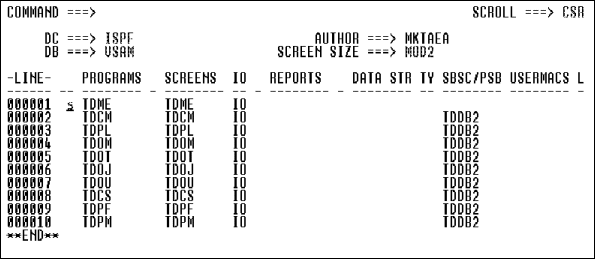
Figure 2-1: A Sample Application Definition
This chapter contains the following sections:
The APS Application Painter lets you define your application by listing all of its components in a matrix. The matrix provides both an overview of the entire application, and easy access to the other APS painters and facilities where you define or import the application components.
An application can include the following components:
These components can define an application of whatever scope you require. For example, one application might be an entire Order Inventory system, while another might be an Order Status database inquiry.
You list application components in the Application Painter screen so that the matrix indicates their relationships. To do so, you type a program name and the names of all the components that belong with the program on one row. If you want multiple programs to share components such as subschemas, data structures, or user-defined macros, you type these component names on one or more rows above your first program. Shared components are known as global components; all programs in your application can reference them.
Figure 2-1: A Sample Application Definition
For example, you first type the name of any global subschema that some or all of your programs access. On the next row, you type the name of the first program and its associated screen. Then you type the other program and screen names on subsequent rows. If you want one of the programs to access a subschema other than the global subschema, you type its name next to that program. If one of your programs is a batch report program, you type the name of its report mock-up, and indicate that the program is a batch program.
Once you name these components, you can use the matrix to navigate to the other APS facilities where you develop the components. As you complete individual programs or the application as a whole, you can return to the Application Painter to generate them into executable COBOL source or to generate reports on the progress of your work.
As part of the application definition, you specify your target environment--the environment where you want your application to run. APS generates your application to run in the database/data communications (DB/DC) environment you specify. You can generate your application for another environment simply by changing your DB/DC target specification.
You can write an application that consists entirely of online programs, entirely of batch programs, or you can mix online programs with batch programs in the same application. In addition, an application--or a single program--can access multiple DB/DC targets. For example, your online programs can use CICS to access VSAM files and SQL databases, while your batch programs access VSAM files and IMS databases.
The Application Painter also supports the prototyping that speeds your development work. This painter lets you access the Scenario Painter, where you can test your application's behavior without having to access your database. For example, you can simulate executing your application, to determine whether its screens display in the sequence you want. You can reorder the sequence as desired, without leaving the Scenario Painter. In addition, the Scenario Painter lets you enter sample data on your screens to test how they accept and display data.
When you are ready to access your database, you can test your application from within APS, using the APS Prototype Execution facility. This facility emulates your production CICS or IMS environment.
To define an application, list components on the Application Painter screen as follows:
|
If application contains . . . |
Specify this DC target . . . |
|---|---|
|
Only online programs |
Your online DC target, such as CICS. For a list of valid DB/DC combinations for generating executable programs to run on various operating systems, see the "DB/DC Target Combinations" topic in the APS Reference. |
|
Only batch programs |
Mvs. Additionally, leave each Screen field and I/O field blank. |
|
Both online and batch programs |
Your online DC target. To identify programs as batch, enter *batch in the Screens field next to each batch program name and leave the I/O fields blank. |
Note: If your application accesses multiple database targets, specify your DB target as follows:
|
If application accesses ... |
Specify this DB target ... |
|---|---|
|
Two DB targets, |
The non-VSAM target; APS always gives you access to the VSAM target. |
|
Two or more DB targets, |
Any of those DB targets. When you generate the programs, first generate the programs of the specified DB target. Then change the DB target to the next target and generate the programs of that target. For example, if your application accesses both SQL and IMS subschemas, generate the SQL programs separately from the IMS programs. |
Note: Specify your target operating system when you prepare to generate the application.
|
Application Screen Size |
Dimension |
Development Screen Size |
|---|---|---|
|
MOD2 |
24 x 80 lines |
MOD2, MOD3, MOD4, or MOD5 |
|
MOD3 |
32 x 80 lines |
MOD3 or MOD4 |
|
MOD4 |
43 x 80 lines |
MOD4 |
|
MOD5 |
27 x 132 lines |
MOD5 |
For batch programs, enter *batch in the Screens field, on the same row as the program name.
You create a data structure using the APS Data Structure Painter. For information, see the "Data Structures" topic in the APS Reference.
|
WS |
Working-Storage Section |
|
LK |
Linkage Section |
|
CA |
Program Commarea |
You import your existing subschema or PSB into APS using the APS Importer Facility. See Import Database Definitions for information.
You create macros using the APS Customization Facility language structures. For information, see the APS Customization Facility User's Guide.
|
Location Code |
Description |
|---|---|
|
T |
Default; top of program, before Identification Division |
|
B |
Bottom of program |
|
WT |
Top of Working-Storage Section |
|
WS |
Working-Storage Section, after any data structures you include in the Data Str field |
|
WB |
Bottom of Working-Storage Section |
|
LT |
Top of Linkage Section |
|
LK |
Linkage Section, after any data structures you include in the Data Str field |
|
LB |
Bottom of Linkage Section |
|
IO |
Top of Input-Output Section |
|
FD |
Top of File Section |
|
RP |
Top of Report Section |
|
CA |
Top of Commarea |
To complete the application, you define each component using other APS painters and facilities, following these steps, in any sequence you want:
Copyright © 2002 Micro Focus International Limited. All rights reserved.
This document and the proprietary marks and names
used herein are protected by international law.